

Daporijo Travel Guide – Exploring Upper Subansiri, Arunachal Pradesh
Orientation – Daporijo, the Heart of Upper Subansiri
Some towns serve merely as overnight halts, and then some places quietly encourage you to slow your pace. Daporijo, the headquarters of Upper Subansiri district in Arunachal Pradesh, belongs firmly in the second category. Standing on the banks of the mighty Subansiri River, the town has gradually become an important stop for travellers exploring the Trans-Arunachal Highway (NH-13), particularly those travelling between Ziro and Aalo.
At first glance, Daporijo appears modest. It is not filled with large hotels, busy shopping streets or tourist attractions competing for attention. Instead, the town introduces visitors to another side of Arunachal Pradesh, where rivers remain central to daily life, bamboo suspension bridges continue to connect villages, forests dominate the landscape, and indigenous traditions remain deeply rooted. For many travellers undertaking a long overland journey across Arunachal Pradesh, Daporijo becomes more than a convenient stop. Spending an extra day here allows time to understand the culture of Upper Subansiri, explore nearby forests, visit ancient places of worship and appreciate the importance of the Subansiri River to local communities.
The town stands at an elevation of approximately 600 metres above sea level, giving it a warmer climate than destinations such as Bomdila or Tawang while remaining considerably cooler than the neighbouring plains of Assam. Although tourism infrastructure is still developing, improved roads under the Trans-Arunachal Highway project have made Daporijo considerably more accessible than it was even a decade ago. This has encouraged more independent travellers, photographers and those interested in exploring lesser-known parts of Arunachal Pradesh.
Upper Subansiri District – Understanding the Region
To appreciate Daporijo, it helps to understand the district that surrounds it. Upper Subansiri is one of the largest districts of Arunachal Pradesh in terms of geographical area. It lies between the districts of Lower Subansiri, Kamle, West Siang and Shi Yomi, while its northern boundary extends towards the Tibetan Autonomous Region of China.
Large parts of the district remain covered by forests, river valleys and mountain ranges. Human settlements are comparatively sparse, and villages are generally located close to rivers or agricultural land. Unlike destinations that have developed around large monasteries or historical monuments, Upper Subansiri has evolved through the interaction between its indigenous communities and the surrounding landscape. Agriculture, bamboo craftsmanship, river-based livelihoods and community festivals continue to shape everyday life.
The district headquarters at Daporijo serves as the administrative, commercial and educational centre for the region. Visitors will find government offices, schools, healthcare facilities, banks, fuel stations, markets and accommodation concentrated within the town.
How Daporijo Developed
Long before modern roads reached Upper Subansiri, movement through this region depended on rivers and foot trails crossing mountain ridges. The arrival of administrative centres during the twentieth century gradually transformed Daporijo into the principal town of Upper Subansiri district. Better road connectivity brought schools, healthcare, government offices and commercial activity, while still allowing the surrounding villages to retain much of their traditional character.
The construction and continuous improvement of the Trans-Arunachal Highway (NH-13) has further strengthened Daporijo's role as an important transit town connecting western and central Arunachal Pradesh. Today, travellers moving between Ziro, Aalo, Mechuka and eastern Arunachal frequently choose Daporijo as an overnight halt.
Why Visit Daporijo?
Many visitors ask whether Daporijo deserves more than a single overnight stay. The answer depends upon how you prefer to travel. If your objective is simply to reach another destination as quickly as possible, one night may be sufficient. However, travellers interested in rivers, indigenous cultures, birdlife, forests and slow overland journeys often discover that Daporijo offers much more than expected.
The town provides opportunities to visit the ancient Meghna Cave Temple, explore bamboo suspension bridges across the Subansiri, walk through reserve forests, interact with members of the Tagin community, and observe everyday life away from the state's more frequently visited destinations.
Its location also makes it an ideal base for exploring different parts of Upper Subansiri district. For photographers, early mornings around the Subansiri River often provide the most rewarding hours of the day. Birdwatchers find the surrounding forests productive throughout much of the year, while those interested in anthropology and indigenous culture can spend time visiting nearby villages with appropriate local guidance.
Getting There
Although Daporijo remains one of the more remote district headquarters in Arunachal Pradesh, improvements in road infrastructure have made the journey considerably easier than in previous years. Private vehicles remain the preferred mode of transport because public transport services are limited and may not always operate according to fixed schedules.
Most visitors reach Daporijo while travelling along National Highway 13, better known as the Trans-Arunachal Highway. The nearest major airport is Dibrugarh Airport (DIB) in Assam. Dibrugarh has regular flight connections with Kolkata, Delhi, Guwahati, Bengaluru and several other Indian cities. From the airport, Daporijo can be reached by road in approximately eight to nine hours, depending upon weather and road conditions.
The opening of the Bogibeel Bridge across the Brahmaputra has significantly reduced travel time from Dibrugarh compared with earlier years, making this the preferred entry point for many visitors. Some travellers also choose to fly into Lilabari Airport near North Lakhimpur when suitable flight schedules are available, although Dibrugarh generally offers better connectivity.
The nearest practical railway stations are Dibrugarh and North Lakhimpur, depending on your travel route. Dibrugarh provides wider rail connectivity with major Indian cities and is therefore the preferred option for most visitors. From either station, onward travel is by road.
Road travel is the most practical way to reach Daporijo. The town lies on the Trans-Arunachal Highway and forms an important stop between several major destinations. Approximate travel times are:
Ziro to Daporijo: Around 170 km, requiring approximately six to seven hours.
Aalo to Daporijo: Around 160 km, taking roughly six to seven hours.
Itanagar to Daporijo: Around 280 km, generally requiring ten to twelve hours depending upon stops.
Dibrugarh to Daporijo: Approximately 320–350 km, normally completed in eight to nine hours.
Although these distances may appear manageable, driving speeds remain relatively low because of mountain roads, occasional landslide-prone stretches and necessary breaks. Starting early in the morning is always advisable.
Driving Across the Trans-Arunachal Highway
The drive itself forms an important part of the experience. Travelling towards Daporijo involves changing landscapes over the course of a single day. The plains gradually give way to forested hills, river valleys become more prominent, villages become smaller, and traffic steadily decreases.
Road conditions have improved substantially during recent years, although ongoing maintenance work and seasonal weather can still influence travel times. Mobile connectivity also becomes less reliable as you move deeper into Upper Subansiri district. Keeping sufficient fuel, drinking water, snacks and cash is always sensible before beginning the journey.
The Subansiri River – Lifeline of Daporijo
Long before visitors notice the town itself, they become aware of the Subansiri River. One of the largest tributaries of the Brahmaputra, the Subansiri originates in Tibet before entering Arunachal Pradesh and eventually flowing into Assam. For the people of Upper Subansiri, the river has always been far more than a geographical feature. It supports agriculture, fishing, transportation and daily household activities while influencing where villages were established over generations.
Throughout Daporijo, the Subansiri dominates the landscape. Traditional bamboo suspension bridges continue to connect communities on opposite banks, while broad gravel beds and changing water levels reveal how powerful the river becomes during the monsoon. Visitors often spend time simply watching local life unfold along its banks, where fishermen, schoolchildren and villagers continue to use the river in ways that have changed little over time.
The Subansiri also provides opportunities for river-based adventure activities during suitable seasons, something explored in greater detail later in this guide.
Planning Your Journey
Because accommodation, permits and transport options remain limited compared with mainstream tourist destinations, planning makes a significant difference. Many travellers combine Daporijo with Ziro, Aalo, Mechuka or other destinations across Arunachal Pradesh, creating a longer road journey through the state rather than treating the town as a standalone destination. Allowing sufficient travel time between destinations, avoiding late-evening driving and confirming accommodation in advance will help ensure a smoother journey.
Major Attractions in Daporijo
Daporijo is not a destination built around large monuments or commercial tourist attractions. Instead, its appeal lies in the landscape, the Subansiri River, indigenous culture and a handful of places that reveal the history and character of Upper Subansiri district. Most visitors spend one or two days exploring the town and its surroundings before continuing towards Aalo, Mechuka or Ziro. Those with an interest in culture, birdwatching or river landscapes often find there is enough to justify a longer stay. Unlike many destinations where attractions are concentrated in one area, the places worth visiting around Daporijo are spread across the town and nearby countryside, making a private vehicle the most convenient way to explore.
Meghna Cave Temple
Among all the places to visit near Daporijo, Meghna Cave Temple holds particular religious and historical significance. Located a short drive from the town, the temple is dedicated to Lord Shiva and is built inside a natural limestone cave. Local people have worshipped here for generations, and today it attracts both pilgrims and travellers interested in archaeology and history. Unlike a conventional temple with elaborate architecture, Meghna Cave Temple retains much of its natural setting. Visitors walk through a forest path before entering the cave, where naturally formed rock formations create the shrine. One of the most interesting aspects of the cave is the presence of ancient inscriptions and carvings that have attracted the attention of historians and archaeologists. Although several local legends explain their origin, much of the site's early history remains uncertain, adding to its importance.
Inside the cave, water continuously drips from the rock ceiling throughout the year, creating a cool atmosphere even during the warmer months. Visitors should carry a torch, wear footwear with good grip and exercise caution while walking inside the cave, particularly during or immediately after the monsoon. Photography is generally permitted outside the shrine, but visitors should always respect local religious customs.
The Subansiri River
No visit to Daporijo is complete without spending time beside the Subansiri River. Originating on the Tibetan Plateau before entering Arunachal Pradesh, the Subansiri is the largest tributary of the Brahmaputra. By the time it reaches Daporijo, the river has already travelled through deep valleys and mountain landscapes, shaping the geography of Upper Subansiri district. For local communities, the river provides water for agriculture, fishing and transportation. Villages were historically established close to its banks because of its importance to daily life.
For visitors, the Subansiri offers constantly changing views throughout the day. Early mornings often bring calm conditions, making it an excellent time for photography. During winter, broad gravel banks become visible, while the monsoon transforms the river into a fast-flowing watercourse carrying enormous volumes of water.
Simply spending time by the river is one of the most rewarding experiences in Daporijo.
River Rafting on the Subansiri
The Subansiri is also recognised as one of the important white-water rafting rivers in Arunachal Pradesh. Depending upon seasonal water levels, sections of the river offer rafting opportunities ranging from moderate to technically demanding.
Professional rafting expeditions occasionally include Daporijo as part of longer river journeys. Because river conditions vary considerably throughout the year, rafting should only be undertaken with experienced operators using appropriate safety equipment.
Travellers interested in rafting should enquire well in advance, as operations are seasonal rather than daily.
Traditional Bamboo Suspension Bridges
Perhaps the most recognisable symbols of Daporijo are its traditional bamboo suspension bridges. Constructed using bamboo, cane and locally available timber, these bridges connect villages separated by the Subansiri River. Although several modern steel bridges have been built in recent years, many traditional bridges continue to remain in use. Walking across one of these structures offers a fascinating glimpse into indigenous engineering techniques that have served local communities for generations.
The bridges also provide excellent viewpoints over the river and surrounding valley. Visitors should cross carefully, particularly after rainfall, and avoid overcrowding the bridge.
Kamala Reserve Forest
The Kamala Reserve Forest lies close to Daporijo and represents one of the district's most valuable natural areas. The forest supports a wide variety of tree species, bamboo, medicinal plants and wildlife typical of the Eastern Himalaya. Although it does not receive the same publicity as larger protected areas elsewhere in Arunachal Pradesh, Kamala Reserve Forest remains an important habitat for birds, butterflies and smaller mammals.
Walking through sections of the forest provides opportunities to observe the changing vegetation of Upper Subansiri. Early mornings are generally the best time for wildlife observation. Visitors interested in natural history should consider hiring local guides familiar with the forest.
Sigem–Daporijo Reserve Forest
Another significant protected area is the Sigem–Daporijo Reserve Forest. Located within the Upper Subansiri landscape, this reserve forms part of the larger forest ecosystem that supports wildlife movement across the district. Dense forests, seasonal streams and bamboo groves dominate much of the area.
Although tourism facilities remain limited, the reserve attracts birdwatchers, botanists and researchers interested in the biodiversity of Arunachal Pradesh. Because the forest receives relatively few visitors, it retains much of its ecological importance. Responsible travel practices are essential while visiting these areas.
Birdwatching Around Daporijo
Upper Subansiri is gradually becoming recognised among birdwatchers. The combination of river valleys, bamboo forests and evergreen woodland supports a wide range of resident and migratory bird species. Depending upon the season, visitors may observe hornbills, barbets, drongos, leafbirds, laughingthrushes, minivets, flycatchers, woodpeckers, kingfishers, eagles and several species of sunbirds.
Bird activity is usually highest shortly after sunrise. A pair of binoculars and a local guide considerably improve the experience.
Daporijo Museum & Craft Centre
Travellers interested in understanding the people of Upper Subansiri should spend some time at the Daporijo Museum & Craft Centre. Although relatively modest in size, it provides an informative introduction to the district's cultural heritage.
The museum displays traditional clothing, ornaments, agricultural implements, hunting equipment, household articles, bamboo crafts and musical instruments used by local communities. Exhibits also explain aspects of traditional housing, farming methods and ceremonial practices. For visitors unfamiliar with Arunachal Pradesh, the museum provides valuable context before exploring nearby villages.
The adjoining craft centre showcases locally made handicrafts and demonstrates the importance of bamboo, cane and weaving in everyday life. Purchasing locally produced handicrafts directly supports artisan families and helps preserve traditional skills.
Good Shepherd Church
The Good Shepherd Church is one of the important Christian places of worship in Daporijo. Its simple design reflects the character of the town rather than elaborate architecture. The church serves as an active centre for the local Christian community and remains peaceful throughout most of the day. Visitors are welcome outside prayer services, provided they dress respectfully and maintain silence inside the building.
The surrounding area also offers pleasant views of the nearby hills.
Local Markets
Daporijo's market provides an opportunity to observe daily life rather than conventional shopping. Farmers arrive with fresh vegetables, seasonal fruits, bamboo shoots, local herbs and agricultural produce from nearby villages. Shops sell handwoven bags, bamboo baskets, traditional ornaments, household items and locally produced handicrafts. The market is also one of the best places to sample local snacks and interact with residents.
Because the town functions as the commercial centre of Upper Subansiri, people from different tribal communities regularly visit the market. This creates an interesting mix of languages, traditional attire and local products throughout the day.
Nature Around Daporijo
The countryside surrounding Daporijo changes noticeably with every season. Winter brings clear views across the river valley and comfortable conditions for walking. Spring introduces flowering trees and increasing bird activity.
During the monsoon, forests become denser while numerous seasonal streams appear along the hillsides. Agricultural fields surrounding villages also change with the farming calendar, adding another dimension to the landscape throughout the year. Travellers who spend time away from the main road often discover quiet village paths, bamboo groves and riverbanks that reveal everyday life in Upper Subansiri.
Tribals and Their Culture
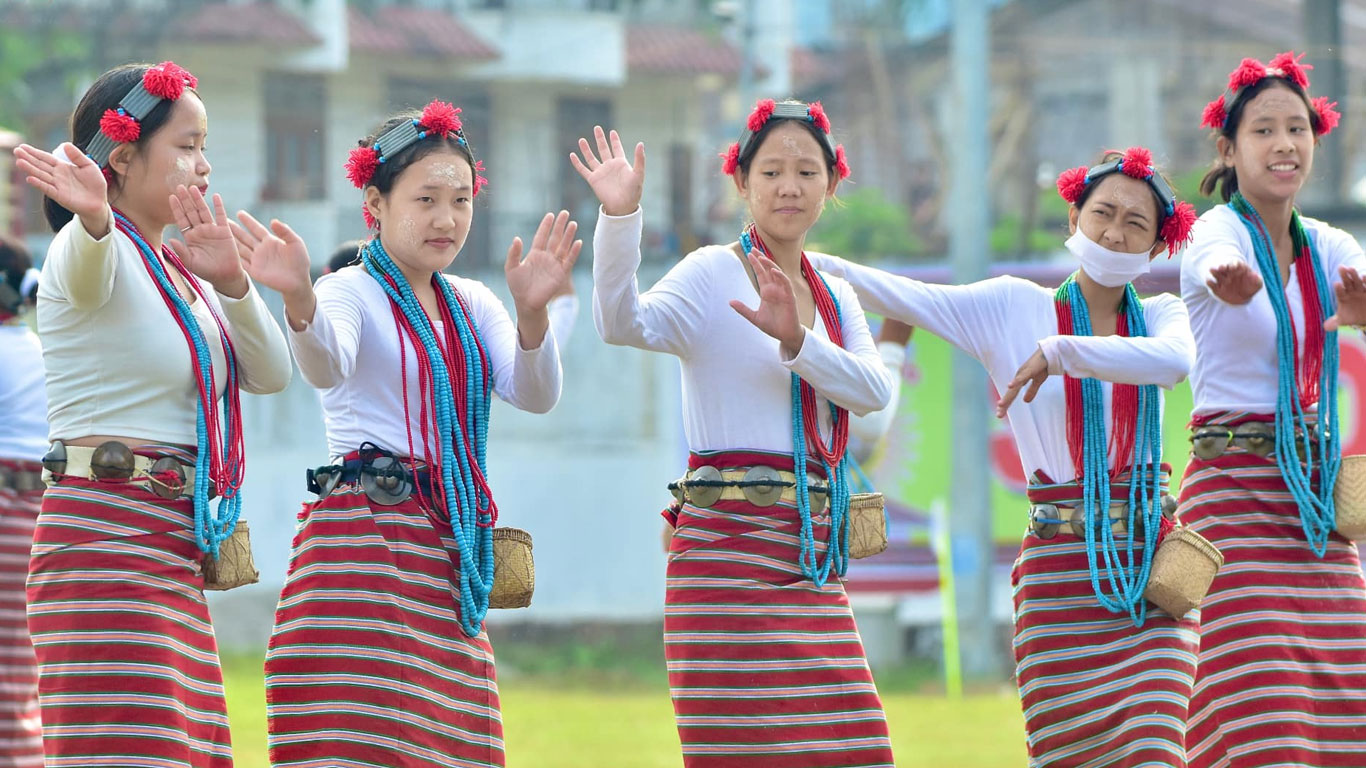
Understanding Daporijo begins with understanding its people. Upper Subansiri is home to several indigenous communities whose history predates the formation of modern Arunachal Pradesh by centuries. Their lives have traditionally revolved around the Subansiri River, the surrounding forests and agriculture, resulting in a culture that remains closely connected with the natural environment.
Unlike many parts of India where urbanisation has significantly altered traditional lifestyles, several villages around Daporijo continue to preserve long-established customs, community institutions and festivals. Visitors travelling respectfully and with local guidance often find conversations with village residents among the most rewarding experiences of their journey.
The Tagin Community
The Tagin community forms the largest indigenous group in Upper Subansiri district and has played a central role in shaping the identity of Daporijo. Traditionally, the Tagins lived in villages situated along river valleys and cultivated crops suited to the region's terrain. Agriculture continues to be an important occupation, with rice, millet, maize and seasonal vegetables grown throughout the district.
Traditional Tagin houses were built using bamboo, timber and cane, usually raised above the ground on wooden stilts. While many modern homes now use concrete, examples of traditional architecture can still be seen in villages around Daporijo. Bamboo remains indispensable in daily life. It is used for house construction, fencing, bridges, baskets, fishing equipment, household utensils and agricultural tools. The skill with which local craftsmen work with bamboo is immediately apparent throughout the district.
Community cooperation also continues to play an important role in village life. Agricultural work, construction and festivals often involve collective participation, reflecting traditions that have been maintained for generations.
Other Communities of Upper Subansiri
Although the Tagins form the majority population around Daporijo, neighbouring areas are also home to communities such as the Galo, Nyishi and Hill Miri, now officially recognised as a subgroup of the Nyishi. Interaction between these communities over centuries has influenced local trade, festivals and cultural exchange.
Government employees, teachers, healthcare workers and business owners from different parts of India have also settled in Daporijo, contributing to the town's multicultural character while respecting the traditions of the indigenous population.
Demography and Language
Daporijo reflects the linguistic diversity that characterises much of Arunachal Pradesh. The Tagin language is widely spoken among residents and belongs to the Tibeto-Burman language family. Hindi has become the principal language for communication between different tribal communities and is understood by most residents.
English is commonly used in schools, government offices and official correspondence. Visitors generally find communication straightforward because many younger residents are comfortable speaking both Hindi and English. This multilingual environment allows travellers to interact easily while also hearing several indigenous languages spoken in markets and villages.
Faith and Traditional Beliefs
Many Tagin families continue to follow Donyi-Polo, an indigenous belief system centred on reverence for the Sun (Donyi) and the Moon (Polo). Nature occupies an important place within this tradition. Mountains, rivers, forests and ancestral spirits are respected through rituals performed during different stages of the agricultural calendar.
Alongside Donyi-Polo, Christianity has gained followers over recent decades, and churches now form an important part of community life in several parts of Upper Subansiri. These belief systems coexist peacefully, contributing to the district's cultural diversity.
Local Festivals
Festivals in Daporijo remain closely linked with agriculture, community welfare and indigenous traditions rather than commercial tourism. Visitors fortunate enough to travel during festival periods gain an opportunity to observe ceremonies that continue to hold genuine social and cultural importance.
Si-Donyi Festival
The most important festival celebrated by the Tagin community is Si-Donyi. Held every year in January, the festival seeks blessings for prosperity, good harvests, harmony and protection from natural calamities. Traditional priests conduct rituals while community members participate in dances, songs and cultural performances.
Visitors may witness colourful ceremonial attire, bamboo decorations and community feasts prepared for the occasion. Si-Donyi has gradually become one of the major cultural festivals of Arunachal Pradesh and attracts visitors interested in indigenous traditions.
Other Community Celebrations
Apart from Si-Donyi, villages observe smaller seasonal festivals connected with agriculture, harvests and family ceremonies. These occasions generally involve traditional music, rice beer prepared according to local customs, folk dances and communal meals.
Because many celebrations are organised at village level, participation by visitors should always be arranged respectfully through local contacts or tour operators.
Food in Daporijo
The cuisine of Upper Subansiri reflects the availability of local ingredients rather than elaborate recipes. Rice forms the staple diet and is accompanied by vegetables, bamboo shoots, smoked meat, river fish and locally grown herbs.
Pork is widely consumed among many indigenous communities and is frequently cooked with bamboo shoots or fermented ingredients that add distinctive flavours. Chicken and freshwater fish are also common. Unlike many parts of India, local food generally relies on simple seasoning that allows the natural taste of ingredients to remain prominent.
Seasonal vegetables collected from forests or cultivated in village gardens frequently appear on the dining table. Visitors staying in a Daporijo homestay often enjoy meals prepared using recipes passed down through generations.
Local Markets and Handicrafts
Daporijo's market serves as the commercial centre for much of Upper Subansiri district. Farmers arrive from surrounding villages carrying fresh vegetables, bananas, oranges, ginger, turmeric and seasonal produce. Traditional bamboo baskets, woven bags, cane products and handmade household items are widely available.
The market also provides an opportunity to observe daily interactions between different tribal communities. Unlike markets created primarily for tourists, Daporijo's market remains an active trading centre where residents purchase everyday necessities.
Best Time to Visit Daporijo
Choosing the Best time to visit Daporijo depends upon your interests, although most travellers prefer the period between October and April. Following the end of the monsoon, October and November bring comfortable temperatures and generally reliable road conditions. The Subansiri River continues to carry substantial water while the surrounding forests remain fresh after the rains.
December to February offers cool mornings and pleasant daytime temperatures. This is also the season when the Si-Donyi Festival takes place, making it one of the most interesting periods for visitors interested in local culture. March and April provide favourable weather for sightseeing, village visits and exploring nearby forests. Bird activity also increases during spring.
The monsoon season, usually from June to September, receives heavy rainfall. Although the forests appear at their greenest, landslides and road disruptions can occasionally affect travel. Overall, the Best time to visit Daporijo is considered to be October to April, when road travel is generally easier, and outdoor activities are more comfortable.
Daporijo Hotels
Travellers should approach accommodation in Daporijo with realistic expectations. The town offers a selection of Daporijo hotels, guest houses and government accommodation rather than luxury resorts. Most properties provide clean rooms, attached bathrooms and simple meals. Hot water may be available through geysers or buckets depending on the property and local power supply.
Although facilities remain basic, hospitality is generally warm, and staff are accustomed to assisting travellers undertaking longer journeys across Arunachal Pradesh. Because accommodation options are limited, reservations are strongly recommended, particularly during winter and festival periods.
Daporijo Homestay
Choosing a Daporijo homestay provides a very different experience from staying in a conventional hotel. Guests usually stay with local families, enjoy home-cooked meals and gain insight into everyday life in Upper Subansiri.
Many hosts are happy to explain local customs, agriculture, festivals and traditional cooking methods. A Daporijo homestay also offers opportunities to taste regional dishes prepared with fresh local ingredients that may not be available in restaurants.
Travellers interested in photography, culture or slow travel generally find homestays especially rewarding.
Daporijo 2 Day Itinerary
Travellers with limited time can still experience the highlights of Daporijo through a carefully planned itinerary.
Day One
Arrive in Daporijo by afternoon. Visit the local market and the Daporijo Museum & Craft Centre. Spend the evening beside the Subansiri River, watching local life unfold along its banks. Stay overnight in one of the Daporijo hotels or choose a Daporijo homestay for a more local experience.
Day Two
Begin early with a visit to Meghna Cave Temple. Continue to the traditional bamboo suspension bridges before exploring Kamala Reserve Forest or Sigem–Daporijo Reserve Forest, depending on available time. Return to Daporijo for lunch before continuing your onward journey towards Aalo, Ziro or other destinations along the Trans-Arunachal Highway.
Travellers with additional time can extend their stay to include nearby villages, birdwatching excursions and longer walks along the Subansiri River.
Why Daporijo Deserves More Than an Overnight Halt
Many visitors arrive expecting Daporijo to be little more than a convenient break between Ziro and Aalo. Those who spend an extra day often leave with a different impression. The rhythm of life here is shaped by the Subansiri River, village traditions and the forests that surround the town. Conversations with residents, visits to the Meghna Cave Temple and walks across bamboo suspension bridges offer experiences that cannot be appreciated from the window of a passing vehicle.
For travellers exploring Arunachal Pradesh by road, Daporijo provides an opportunity to slow down, understand Upper Subansiri and experience a part of the state that continues to receive comparatively few visitors.
Permits Required for Visiting Daporijo
Like every district in Arunachal Pradesh, Daporijo requires valid travel permits before entry. Indian citizens must obtain an Inner Line Permit (ILP). The permit can be applied for online through the Arunachal Pradesh Government portal or obtained from designated offices in Guwahati, Kolkata, Delhi, Tezpur, Dibrugarh and Itanagar. Online applications have made the process considerably easier, but travellers should complete the formalities before beginning their journey.
Foreign nationals require a Protected Area Permit (PAP). Regulations regarding PAPs occasionally change, so it is advisable to verify the latest requirements while planning your visit. If you are travelling through multiple destinations such as Ziro, Daporijo, Aalo, Mechuka or Tawang, your itinerary should be planned so that permits cover your complete route.
At NBTT Travel Solution Private Limited, we arrange all permit formalities as part of our Arunachal Pradesh tours, allowing you to focus on the journey rather than paperwork.
Daporijo Taxi and Local Transport
Public transport within Upper Subansiri remains limited. Shared Sumos operate between major towns, but departures depend on passenger availability and fixed timings. These vehicles are economical but offer little flexibility for sightseeing.
For travellers wishing to visit Meghna Cave Temple, the Subansiri River, nearby villages or the reserve forests, hiring a Daporijo taxi is the most practical option. A dedicated vehicle allows you to stop at viewpoints, local markets and villages without worrying about transport schedules. Since vehicles are limited, especially during the tourist season, booking is advisable.
Car Rental for Daporijo
Most visitors exploring Arunachal Pradesh prefer to hire one vehicle for the entire circuit instead of arranging transport town by town. A professional car rental for Daporijo becomes particularly useful because distances are long, road conditions vary, and public transport may not match your itinerary.
Vehicle options generally include comfortable SUVs such as Innova Crysta, Mahindra Scorpio and Bolero for families and small groups, while Tempo Travellers are suitable for larger groups. Experienced local drivers understand mountain roads, weather conditions and permit checkpoints, making the journey considerably more comfortable and safer.
At NBTT, all vehicles are planned according to group size, luggage requirements and the overall route across Arunachal Pradesh.
Daporijo Tour Package
A well-planned Daporijo tour package is rarely limited to Daporijo alone. Most travellers include the town as part of a longer journey through central and western Arunachal Pradesh.
Popular combinations include: Ziro – Daporijo – Aalo
This route follows the Trans-Arunachal Highway and introduces travellers to different tribal communities, river valleys and changing landscapes. Dibrugarh – Ziro – Daporijo – Aalo – Mechuka
Ideal for travellers with 10 to 12 days who wish to experience several lesser-visited regions of Arunachal Pradesh. Itanagar – Ziro – Daporijo – Aalo
Suitable for visitors entering Arunachal Pradesh from the south-west. Every Daporijo tour package offered by NBTT includes transport planning, permits, accommodation and route optimisation to reduce unnecessary driving time.
Arunachal Pradesh Tour Package Including Daporijo
Because of its central location, Daporijo fits naturally into a longer Arunachal Pradesh Tour Package. Rather than flying between destinations, most visitors travel by road, allowing them to experience the changing geography and cultural diversity of the state.
A comprehensive itinerary may include: Guwahati – Bhalukpong – Bomdila – Tawang – Dirang – Itanagar – Ziro – Daporijo – Aalo – Mechuka – Dibrugarh.
Another popular circuit focuses entirely on central Arunachal: Dibrugarh – Ziro – Daporijo – Aalo – Mechuka – Pasighat.
The exact route depends upon available time, seasonal road conditions and traveller interests.
Practical Travel Advice
Travelling in Daporijo differs from visiting mainstream tourist destinations, and a little preparation makes the experience far more comfortable. Carry sufficient cash, as ATMs are limited and may occasionally be out of service. Digital payments have become increasingly common in recent years, but network connectivity can still be inconsistent in remote areas. Mobile coverage has improved, with BSNL, Airtel and Jio available in parts of the district, although signal strength varies considerably outside the town.
Electricity supply is generally reliable but occasional interruptions can occur during bad weather. Pack comfortable walking shoes, a rain jacket during the monsoon, warm clothing for winter evenings and any essential medicines, as specialised medical facilities are limited.
Road conditions in Arunachal Pradesh change due to rainfall, maintenance work and landslides. Keeping one buffer day in a longer itinerary is always a sensible idea.
Shopping in Daporijo
Shopping in Daporijo is less about branded products and more about locally made items. Visitors often purchase bamboo baskets, woven bags, traditional textiles, handmade ornaments and locally produced spices.
Seasonal agricultural products, including oranges, ginger and turmeric, are also popular when available. Buying directly from local artisans supports village livelihoods and helps preserve traditional craftsmanship.
Frequently Asked Questions About Daporijo
Is Daporijo worth visiting?
Yes. Daporijo is one of the best places to understand the culture of Upper Subansiri while enjoying the Subansiri River, traditional suspension bridges and relatively less-visited parts of Arunachal Pradesh.
How many days should I stay in Daporijo?
One night is sufficient for travellers simply passing between Ziro and Aalo. Two nights allow enough time to visit Meghna Cave Temple, explore nearby forests and experience local culture without rushing.
What is the Best time to visit Daporijo?
The Best time to visit Daporijo is from October to April, when weather conditions are generally favourable and road travel is easier.
Are permits compulsory?
Yes. Indian citizens require an Inner Line Permit (ILP), while foreign nationals need a Protected Area Permit (PAP), subject to prevailing government regulations.
Can I reach Daporijo by public transport?
Shared Sumos and buses operate on some routes, but services are limited. Most visitors prefer hiring a private vehicle.
Are there good Daporijo hotels?
There are several clean and comfortable Daporijo hotels suitable for overnight stays. Facilities are simple rather than luxurious, but most provide everything required for travellers exploring Arunachal Pradesh.
Is staying in a Daporijo homestay a good idea?
Yes. Choosing a Daporijo homestay offers opportunities to interact with local families, learn about Tagin culture and enjoy traditional home-cooked meals.
Is internet connectivity available?
Yes, but speeds vary considerably. Mobile data works reasonably well in parts of Daporijo town but becomes unreliable outside populated areas.
Can families visit Daporijo?
Certainly. Families interested in culture, nature and road journeys generally enjoy Daporijo. However, they should be prepared for long driving hours between destinations.
Can Daporijo be combined with Mechuka and Ziro?
Absolutely. This is one of the most popular travel circuits in central Arunachal Pradesh and is frequently included in customised itineraries.
Plan Your Journey with NBTT Travel Solution Private Limited
Exploring Daporijo is easiest when transport, permits and accommodation are organised in advance.
For more than 25 years, NBTT Travel Solution Private Limited has been designing customised journeys across Arunachal Pradesh and the Eastern Himalaya. Our team understands the practical challenges of travelling through remote mountain regions and plans every itinerary with realistic driving distances, dependable accommodation and experienced local drivers.
Whether you are looking for a short Daporijo tour package, a longer Arunachal Pradesh Tour Package, or a tailor-made journey covering Ziro, Aalo, Mechuka and other destinations, we can arrange every aspect of your trip, including permits, hotels, homestays, transport and local guidance.
For itinerary planning, permits, hotel reservations or vehicle bookings, call NBTT Travel Solution Private Limited on +91 9733300696.
Travel through Arunachal Pradesh with a team that has been exploring these roads for over two decades.
East Himalaya
-
Address:NBTT Travel Solution Private Limited, 19, MN Sarkar Road, Sevoke More Siliguri, State : West Bengal, Country : India. PIN : 734001
-
Call Us at:
+91-9733300696 -
Mail Us:
info@east-himalaya.com
