
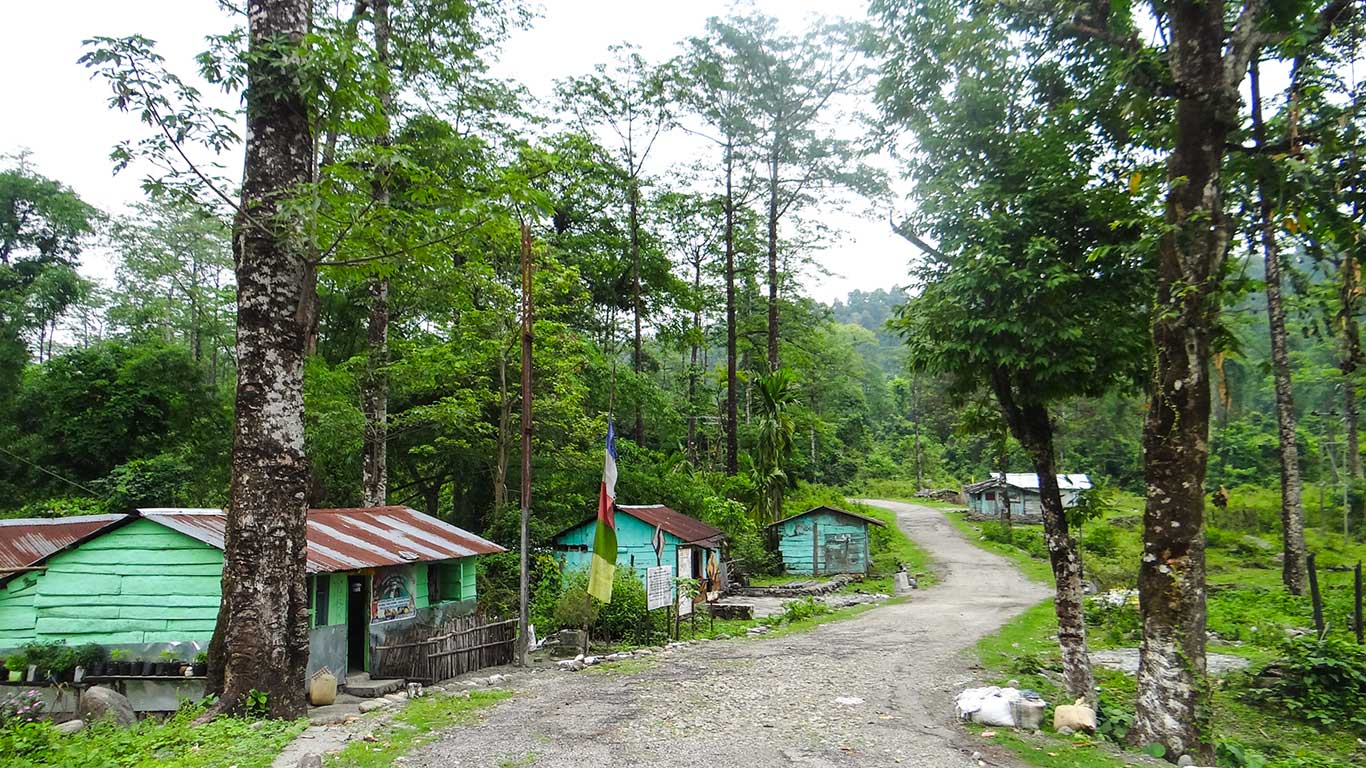

Gorubathan – Where the Hills Meet the Dooars
Gorubathan is one of North Bengal's quieter destinations, tucked into the transition zone where the lower Himalayan hills descend towards the Dooars. It is a place of tea gardens, forested slopes, rivers, village roads and old historical remnants rather than a conventional hill-station experience.
For travellers looking for an offbeat destination in North Bengal, Gorubathan offers something increasingly difficult to find around the more popular hill towns: space, silence and a landscape that still feels closely connected to everyday local life.
Known locally as Sombare, Gorubathan takes its name from the traditional Monday market that remains an important part of the settlement's character. The town lies along the Chel River and provides a convenient base for exploring the surrounding tea gardens, viewpoints, forests and villages. It also occupies an interesting position for travellers who want to combine the lower hills with destinations such as Lava, Jhandi, Samsing and the wider Dooars.
A good Gorubathan tour is therefore less about ticking off sightseeing points and more about exploring the landscape at an unhurried pace.
Where Is Gorubathan?
Gorubathan is in Kalimpong district, on the eastern side of the Chel River. Geographically, it sits between the higher Himalayan settlements around Lava and the lower tea-growing and forested landscape of the Dooars.
This location is one of Gorubathan's greatest strengths.
The elevation is considerably lower than Lava or Kalimpong, so the surroundings have a distinctly different character. Tea gardens spread across the lower slopes, tropical and subtropical vegetation dominates the valleys, and the hills rise gradually rather than appearing as steep mountain walls.
The approach to Gorubathan is particularly attractive. From the Dooars side, the road leaves the main highway near Damdim and begins moving through tea-garden country. The landscape becomes progressively quieter as the road follows the contours towards Gorubathan.
For travellers arriving from Siliguri, NJP or Bagdogra, this relatively easy approach makes Gorubathan a practical choice for a first experience of the lower Himalayan foothills.
Gorubathan from Siliguri
The journey from Siliguri to Gorubathan is primarily a road journey through the Dooars foothills.
The route initially passes through the busy plains and tea-growing belt before reaching the Damdim side. From there, the road towards Gorubathan becomes quieter and more scenic, with tea estates and forested slopes replacing the urban landscape.
Depending on the exact starting point, route and traffic, the journey generally takes a few hours rather than requiring a full day of travel.
A private vehicle is particularly useful because the journey itself can become part of the holiday. Rather than treating Gorubathan simply as a destination at the end of a transfer, travellers can stop at suitable viewpoints, tea-garden surroundings and riverside areas along the way.
Gorubathan from NJP
For travellers arriving by train, NJP is the most practical major railway gateway to Gorubathan.
A reserved vehicle from NJP provides considerably more flexibility than trying to combine several local transport connections. This is especially useful for families, senior travellers and visitors carrying luggage.
Another possible railhead for some journeys is Malbazar, after which Gorubathan can be approached by road.
The best option depends on the train schedule and the rest of the itinerary. Gorubathan can easily be incorporated into a wider North Bengal journey rather than treated as an isolated destination.
Gorubathan from Bagdogra
Travellers arriving by air can reach Gorubathan by road from Bagdogra Airport.
The road journey first crosses the plains before gradually entering the tea and forest country of the Dooars. A private car is normally the most convenient arrangement, particularly when Gorubathan is the first stop of a multi-day trip.
One advantage of arriving directly at Gorubathan rather than staying in Siliguri is that the holiday begins in the quieter landscape almost immediately.
The Chel River – The Natural Heart of Gorubathan
The Chel River is inseparable from the character of Gorubathan.
The river flows through a landscape of forest, tea gardens and low hills, creating a series of peaceful riverside stretches around the town. During the drier months, exposed stones and shallow channels make parts of the river particularly attractive for sitting, photography and quiet walks.
The river landscape is not a manicured tourist attraction. That is precisely its appeal.
Near the approach to Gorubathan, smaller streams including Fagu Khola, Runjung Khola and Chel Khola come together within the wider river system. Across the river, tea gardens add another layer to the scenery.
A riverside visit should always take seasonal conditions seriously. During heavy rain, water levels and currents can change quickly, and places that appear harmless in winter may become dangerous during the monsoon.
Dalim Fort Gorubathan
Among the most interesting historical places to visit in Gorubathan is Dalim Fort.
The remains occupy higher ground above the town and are associated with the historical Bhutanese presence in this frontier region. What survives today is largely made up of weathered stone structures and ruins rather than an intact fort.
That is part of what makes the site interesting.
Dalim Fort is not a polished heritage attraction with extensive interpretation and reconstructed buildings. Instead, the ruins sit within the landscape, and reaching them involves a short uphill walk or trek.
The real reward is the combination of history and scenery. From the higher ground, the surrounding hills, valleys and lower Dooars landscape become visible, helping visitors understand why this region was strategically important in the past.
Anyone visiting Dalim Fort should wear proper footwear and allow sufficient time rather than treating it as a rushed roadside stop.
Jhandi Dara
Jhandi Dara is one of the most rewarding viewpoints accessible from the Gorubathan area.
Its appeal comes from the unusual geographical perspective. On a clear day, the higher Himalayan ranges can appear towards one side while the broad Dooars landscape stretches away in another direction.
Sunrise and sunset are particularly attractive, but visibility is entirely weather-dependent. A cloudy morning can produce a completely different experience from a clear winter day.
If mountain views are important to your trip, avoid building the entire itinerary around a guaranteed panorama. The weather changes quickly in this part of North Bengal.
Gorubathan Tea Garden
Tea is one of the defining features of the Gorubathan landscape.
The roads around the town pass through extensive tea-growing areas, and the contrast between neatly arranged tea bushes, forested hills and river valleys gives the region much of its visual identity.
For visitors, a tea garden is best experienced slowly. Walk along permitted roads, observe the changing landscape and, where permission is available, learn about plantation life and tea production.
Tea estates are working environments rather than public parks. Travellers should not enter private plantation areas, factories or worker settlements without permission.
The Gorubathan tea garden experience is therefore less about finding a single tourist attraction and more about understanding how tea agriculture fits into the landscape and lives of the surrounding communities.
Sakham Forest
Sakham is another worthwhile excursion from Gorubathan for travellers interested in forests and quieter natural surroundings.
The road towards the area passes through greenery and tea-garden landscapes before reaching the forested surroundings. The Mal and Neora river systems add to the scenery, while the relatively low tourist pressure makes this a pleasant place for a short nature-oriented outing.
A small hydroelectric installation is also associated with the area.
Sakham works particularly well for travellers who do not want every day of their holiday to revolve around formal sightseeing. A slow drive, a short walk and time spent in the surrounding landscape can be more rewarding here than trying to fill the day with activities.
Faforkheti
Faforkheti is a small settlement on the road towards Lava and is representative of the kind of places that make Gorubathan sightseeing different from sightseeing in a conventional tourist town.
There are no major monuments or commercial attractions here. Instead, the interest lies in the landscape, village setting and road journey.
For photographers and travellers interested in rural North Bengal, these smaller settlements often provide a better sense of the region than heavily visited viewpoints.
Faforkheti also has strategic importance for travellers planning a circuit between Gorubathan and Lava.
Gorubathan to Lava
The road from Gorubathan to Lava is one of the most interesting extensions of a Gorubathan itinerary.
As the road climbs, the landscape changes noticeably. The warmer, greener character around Gorubathan gradually gives way to cooler hill vegetation and a more pronounced mountain environment.
This makes the two destinations complementary rather than repetitive.
Gorubathan can provide the lower-hill and Dooars experience, while Lava introduces the higher Himalayan environment. Depending on the route and road conditions, the journey can also be combined with villages and viewpoints along the way.
For travellers with enough time, staying in both locations is preferable to attempting to experience the entire route as a hurried day trip.
Can Lava Be Covered as a Day Trip?
Yes, Lava can be visited from Gorubathan as a day excursion, but whether this is sensible depends on the rest of the itinerary.
If the purpose is simply to see Lava and return, the day can become dominated by driving. If you have a genuine interest in the route, viewpoints and villages, it can be worthwhile.
For a relaxed holiday, however, two or three nights in Gorubathan followed by a separate stay in Lava often produces a better experience.
This also gives you some flexibility if weather affects visibility or road conditions.
Things to Do in Gorubathan
Gorubathan is particularly suited to travellers who enjoy slow, nature-based experiences.
Walk Through Tea-Garden Country
The tea estates surrounding Gorubathan provide excellent opportunities for quiet walks where access is permitted.
Early morning is particularly pleasant, when the air is cooler and the landscape is often quieter.
Spend Time Beside the Chel
Rather than simply photographing the river and leaving, give yourself time to experience it.
Sit beside the water, walk along suitable stretches and watch how the landscape changes with the light.
Visit Dalim Fort
The short trek to Dalim Fort combines history, walking and panoramic scenery.
It is one of the few places around Gorubathan where the historical character of the region becomes particularly tangible.
Watch Sunrise or Sunset at Jhandi Dara
Jhandi Dara is best approached with patience. Clear weather is essential for distant Himalayan views, so allow some flexibility in your schedule.
Explore the Village Roads
Some of the most memorable experiences in Gorubathan come without a formal sightseeing label.
Small roads through tea gardens, village settlements, forest edges and river valleys allow you to see how people actually live in this part of North Bengal.
Birdwatching and Nature Observation
The combination of forests, streams, tea gardens and river corridors provides a good environment for birdwatching.
Carry binoculars if birds are an important part of your travel interest, and start early.
Take the Road Towards Lava
Even if Lava itself is not included in the day's plan, the road towards it is worth experiencing.
The changing vegetation and elevation provide a natural introduction to the Eastern Himalayan landscape.
Places to Visit in Gorubathan
For travellers preparing a shortlist of Gorubathan tourist places, the most useful places and experiences include:
- Dalim Fort – history, walking and panoramic views.
- Jhandi Dara – mountain and Dooars views.
- Chel River – riverside landscape and quiet breaks.
- Gorubathan tea gardens – plantation scenery and local landscape.
- Sakham Forest – forest surroundings and nature.
- Faforkheti – village landscape on the Lava road.
- Nearby tea estates and rural settlements – best explored at an unhurried pace.
- Lava – a worthwhile extension for travellers with additional time.
The important distinction is that some of these are destinations while others are experiences. Gorubathan is best appreciated when both are included.
Gorubathan as an Offbeat Destination
The biggest attraction of Gorubathan is arguably what it does not have.
It does not have the crowded Mall Road atmosphere of Darjeeling, the heavy commercialisation of some popular hill resorts or the constant stream of tourists found at more established destinations.
Instead, you get tea gardens, local markets, rivers, forest roads and homestays.
That makes Gorubathan an excellent offbeat destination for couples, families who prefer quiet holidays, photographers, nature lovers and travellers who have already explored the more conventional North Bengal circuits.
It is also particularly suitable for travellers who want to spend time at their accommodation rather than moving from one attraction to another every few hours.
Gorubathan Homestays and Accommodation
Accommodation around Gorubathan is relatively dispersed.
You will find simple hotels and lodges closer to the main settlement, while homestays are scattered across surrounding villages and higher locations.
A Gorubathan homestay can be a particularly good choice if your priority is local interaction and a quieter setting rather than resort-style facilities.
Some properties around Gorubathan and the nearby tea-garden areas offer more comfortable accommodation, while higher settlements such as Jhandi and areas towards Faforkheti provide different experiences altogether.
When choosing accommodation, location is more important than simply looking at room photographs.
If your priority is sightseeing, stay somewhere with easy road access. If your priority is views and tranquillity, a higher homestay may be preferable. If you intend to combine Gorubathan with Lava, choosing accommodation along the connecting route can save considerable driving time.
What Kind of Traveller Will Enjoy Gorubathan?
Gorubathan is particularly suitable for:
- Couples seeking a quiet hill-and-forest escape.
- Families wanting a less crowded North Bengal destination.
- Travellers interested in tea gardens and rural landscapes.
- Photographers and birdwatchers.
- Visitors looking for an offbeat North Bengal holiday.
- Travellers combining the Dooars with Lava or other Eastern Himalayan destinations.
- People who enjoy road journeys and scenic drives.
It is less suitable for someone looking for nightlife, extensive shopping or a large collection of conventional tourist attractions.
Gorubathan Weather
Gorubathan's lower elevation gives it a noticeably warmer climate than Lava or higher hill destinations.
Winter mornings can be cool, while daytime temperatures are generally comfortable. Spring and early summer become progressively warmer.
The monsoon is the wettest period, and rainfall can be substantial. This is responsible for much of the region's lush vegetation but can also cause temporary disruption to road travel.
Weather in the hills can change quickly. A clear morning does not necessarily mean that distant mountain views will remain visible throughout the day.
Frequently Asked Questions About Gorubathan
Is Gorubathan worth visiting?
Yes, particularly if you enjoy quiet destinations, tea gardens, rivers, forest landscapes and rural mountain life. It is better suited to slow travel than conventional sightseeing.
How many days are enough for Gorubathan?
Two nights are enough for a short introduction. Three nights allow a more relaxed experience and make it easier to include Dalim Fort, Jhandi Dara and nearby areas.
Is Gorubathan suitable for a family holiday?
Yes. Its relatively accessible road approach and peaceful surroundings make it suitable for families. Accommodation should be selected according to the age and mobility of the group.
What are the best places to visit in Gorubathan?
Dalim Fort, Jhandi Dara, the Chel River, surrounding tea gardens, Sakham Forest and the villages along the Lava road are among the most worthwhile experiences.
Can Gorubathan be combined with Lava?
Yes. Gorubathan to Lava is a particularly logical combination because the two destinations offer contrasting landscapes and can be linked by road.
Is Gorubathan a hill station?
Not in the conventional sense. Gorubathan is better described as a lower-hill settlement in the transition between the Eastern Himalayas and the Dooars.
Is Gorubathan good for an offbeat holiday?
Very much so. Its relatively low tourist pressure, homestays, tea gardens, rivers and rural surroundings are precisely what make it attractive as an offbeat destination.
Which is better for views, Gorubathan or Lava?
They offer different experiences. Lava provides a distinctly higher Himalayan environment, while Gorubathan combines lower hills, tea gardens, rivers and views towards the Dooars. For travellers with time, experiencing both is preferable.
Can I visit Gorubathan during the monsoon?
Yes, but monsoon travel requires flexibility. Heavy rain can affect roads and river conditions. It is a better choice for travellers who enjoy greenery, mist and slow stays than for those planning a tightly packed sightseeing itinerary.
Is a homestay a good option in Gorubathan?
Yes. A homestay is often one of the better ways to experience the quieter side of Gorubathan and interact with local communities. Choose the location based on your sightseeing plans and required facilities.
Plan Your Gorubathan Tour with NBTT Travel Solution
Gorubathan is a destination where the quality of the journey matters as much as the list of places you visit.
A well-designed Gorubathan tour should leave enough time for the Chel River, tea gardens, viewpoints and village roads instead of turning every day into a long sequence of car journeys. If Lava is included, the itinerary should also account for the change in altitude and landscape rather than treating it as just another sightseeing point.
NBTT Travel Solution Private Limited can help arrange the vehicle, accommodation and overall itinerary according to the way you want to experience Gorubathan.
Whether you are looking for a quiet Gorubathan homestay, a family holiday, a couple's escape, an offbeat North Bengal circuit or a combined Gorubathan–Lava–Dooars journey, the itinerary can be designed around realistic travel times and the character of each destination.
Call NBTT Travel Solution Private Limited at +91 9733000593 to plan your Gorubathan journey.
Gorubathan is not a destination that needs to be rushed.
Give it a few days, take the slower roads, sit beside the Chel, walk through the tea country and watch the hills change with the light—and the place begins to make sense.
East Himalaya
-
Address:NBTT Travel Solution Private Limited, 19, MN Sarkar Road, Sevoke More Siliguri, State : West Bengal, Country : India. PIN : 734001
-
Call Us at:
+91-9733300696 -
Mail Us:
info@east-himalaya.com
