
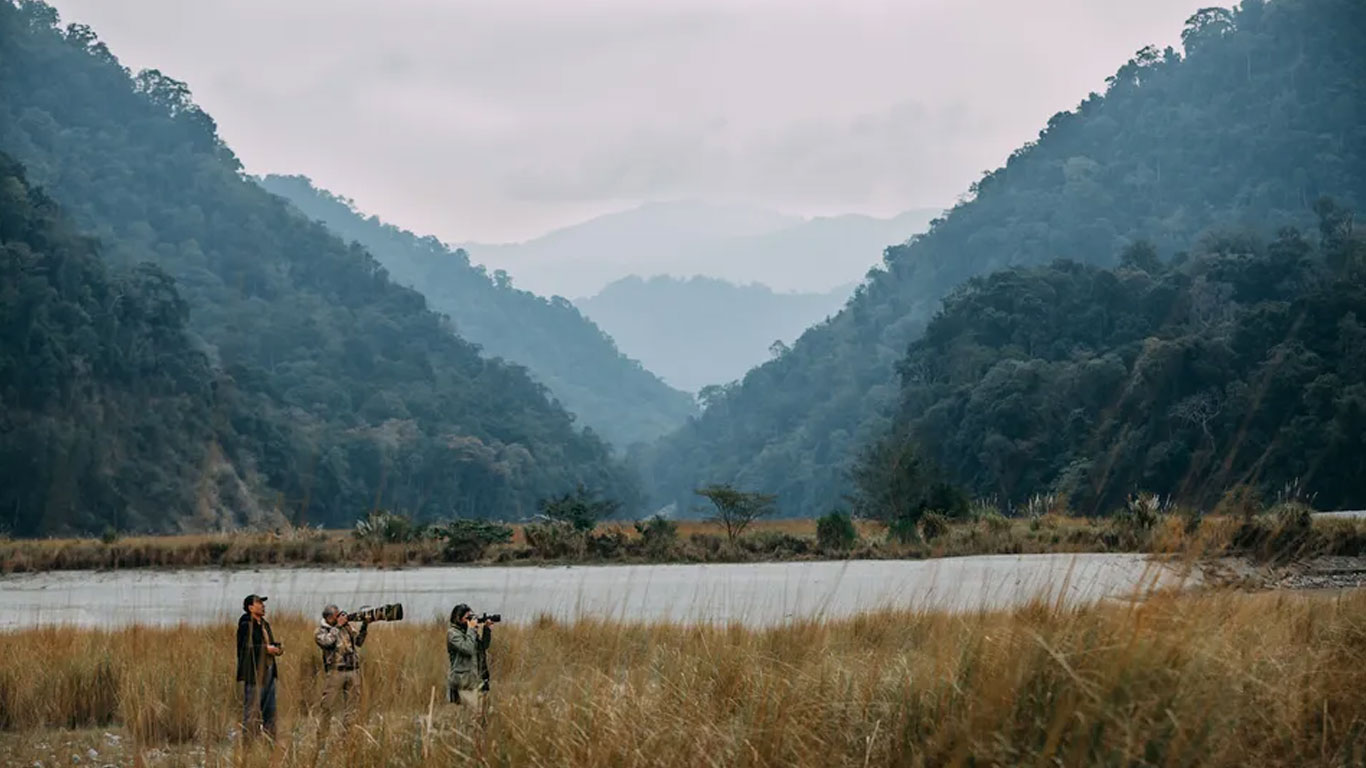

Namdapha National Park Travel Guide
Orientation
Namdapha National Park occupies a special place on the map of India. Covering nearly 1,985 square kilometres in the Changlang district of Arunachal Pradesh, it is the country's third-largest national park and one of the largest protected forests in the Eastern Himalayas. The park also forms the core of the Namdapha Tiger Reserve, a globally recognised conservation landscape that protects one of Asia's richest collections of plants and wildlife.
Located at the eastern edge of Arunachal Pradesh, Namdapha shares ecological boundaries with Myanmar, while its western approaches connect with Assam through the town of Miao. Unlike many national parks where visitors spend a few hours on a jeep safari, Namdapha is designed for travellers who enjoy walking through forests, observing wildlife patiently and spending time in one of India's most biologically diverse regions.
One of the most remarkable aspects of Namdapha is its enormous variation in altitude. The park begins at approximately 200 metres above sea level in the Noa-Dihing Valley and rises to over 4,500 metres in the Dapha Bum mountain range. Few protected areas in the world contain such dramatic changes in elevation within a single landscape. This variation creates an extraordinary range of habitats, beginning with tropical evergreen forests and extending through subtropical forests, temperate broadleaf forests, conifer forests and alpine meadows.
The park forms part of the internationally recognised Indo-Burma Biodiversity Hotspot, one of the world's most significant regions for biological diversity. Scientists continue to discover new species here, while many areas remain only partially explored because of the difficult terrain.
Unlike wildlife destinations where sightings are almost guaranteed, Namdapha rewards patience rather than speed. Visitors rarely come here expecting to see large mammals every few kilometres. Instead, they come for the experience of walking through forests that remain largely unchanged for centuries, listening to birds, crossing mountain streams and discovering how different ecosystems merge into one another across changing elevations.
Tourism in Namdapha remains deliberately limited. Most visitor activities are concentrated around Miao, Deban and selected trekking routes where tourism can be managed without disturbing fragile ecosystems. Large sections of the park remain inaccessible except to researchers, forest officials and experienced expedition teams.
For travellers planning an Arunachal Pradesh Tour Package, Namdapha provides a completely different experience from destinations such as Tawang, Ziro or Mechuka. Rather than monasteries and mountain towns, the emphasis here is on forests, wildlife, tribal communities and conservation.
History of Namdapha National Park
Although the forests of Namdapha have existed for millions of years, formal wildlife protection began only during the second half of the twentieth century.
For generations, indigenous tribal communities lived around these forests, relying on them for food, medicinal plants, bamboo, timber and traditional livelihoods. Their understanding of the landscape developed through centuries of coexistence with the natural environment.
Recognising the ecological importance of the region, the Government of Arunachal Pradesh declared Namdapha a Wildlife Sanctuary in 1972.
Its conservation status was further strengthened in 1983, when it was upgraded to a National Park and simultaneously became part of Project Tiger, India's flagship wildlife conservation programme.
Subsequently, Namdapha also received recognition as a Tiger Reserve, protecting one of India's largest remaining forest ecosystems.
Despite decades of scientific research, large portions of the park continue to remain insufficiently studied. Difficult terrain, dense forests, heavy rainfall and limited access mean that new botanical and zoological discoveries continue to emerge from the region.
Today, Namdapha represents not only an important wildlife reserve but also one of India's most significant centres for ecological research, conservation biology and environmental education.
The Meaning of the Name
The word Namdapha is generally believed to originate from local Singpho language traditions.
"Nam" refers to water or river, while "Dapha" is associated with the source or origin. The name reflects the importance of the numerous mountain streams that eventually combine to form the Noa-Dihing River, the principal river flowing through the national park.
Water shapes almost every aspect of Namdapha's ecology. Seasonal streams, rivers, marshes and forest pools provide habitats for amphibians, reptiles, fish, insects and countless other forms of life.
Geography and Landscape
Namdapha occupies the south-eastern corner of Arunachal Pradesh within the Changlang district.
The western entrance lies close to Miao, while the eastern boundary approaches the international border with Myanmar.
The park is bounded by the Patkai Hills to the south and the Mishmi Hills to the north, creating a complex mountain landscape cut by rivers, valleys and dense forests.
The Noa-Dihing River forms the ecological backbone of the park. Originating in Myanmar before entering Arunachal Pradesh, it flows westward through Namdapha, creating floodplains, gravel beds and riparian forests that support an exceptional variety of wildlife.
The altitudinal variation is perhaps Namdapha's defining geographical feature.
At lower elevations, tropical evergreen forests dominate the landscape with towering trees, dense bamboo growth and abundant climbers.
Higher slopes gradually transition into subtropical broadleaf forests before giving way to temperate oak, maple and rhododendron forests.
Still higher elevations support conifer forests, alpine scrub and open mountain meadows.
Because these habitats exist within a relatively compact geographical area, Namdapha supports an unusually high concentration of plant and animal species.
Annual rainfall exceeds 3,000 millimetres across much of the park, with the southwest monsoon influencing weather between June and September.
Humidity remains high throughout most of the year, supporting dense forest growth and numerous freshwater ecosystems.
Biodiversity — One of India's Richest Natural Landscapes
Namdapha is internationally recognised as one of India's richest centres of biodiversity.
More than 1,000 plant species have been documented, including numerous orchids, ferns, bamboos, medicinal plants and rare trees.
The park's forests contain valuable timber species alongside giant cane, wild bananas, palms and flowering shrubs.
For botanists, Namdapha functions as a living laboratory where Himalayan, Indo-Malayan and Southeast Asian plant communities overlap.
Its wildlife is equally remarkable.
Namdapha is one of the very few protected areas in the world where the historical ranges of four large cats overlap:
Royal Bengal Tiger
Indian Leopard
Clouded Leopard
Snow Leopard
Although sightings of these animals are extremely uncommon because of dense forests and low population densities, their presence illustrates the ecological importance of the park.
The forests also support:
Red Panda
Himalayan Black Bear
Asiatic Black Bear
Marbled Cat
Golden Cat
Leopard Cat
Wild Dog (Dhole)
Sambar
Barking Deer
Serow
Gaur
Hoolock Gibbon
Slow Loris
Capped Langur
Several species of civets, martens, squirrels and bats.
One of the park's most famous residents is the Namdapha Flying Squirrel, a species scientifically described from this region and considered among India's rarest mammals.
Although it has rarely been recorded, its existence highlights how much remains to be discovered within these forests.
Birdlife
For birdwatchers, Namdapha ranks among India's premier destinations.
More than 425 species of birds have been recorded, with new observations continuing as surveys expand.
Hornbills dominate many forest areas, including the Great Hornbill, Wreathed Hornbill and Oriental Pied Hornbill.
Laughingthrushes, babblers, flycatchers, sunbirds, woodpeckers, kingfishers, eagles, owls and pheasants occur across different elevations.
Winter attracts additional migratory species, while resident forest birds remain active throughout the year.
Because habitats change rapidly with altitude, birdwatchers often encounter completely different species within relatively short distances.
Butterflies, Reptiles and Amphibians
Namdapha also supports extraordinary diversity among smaller animals.
Hundreds of butterfly species have been recorded, particularly during spring and the post-monsoon season.
The warm, humid forests provide ideal conditions for frogs, salamanders, geckos, skinks and numerous snake species.
Freshwater streams contain a wide variety of fish, aquatic insects and crustaceans that form the foundation of complex food chains throughout the park.
Getting There
Reaching Namdapha requires careful planning, but transport has become considerably easier over the last decade due to improved roads connecting Assam with eastern Arunachal Pradesh.
The nearest airport is Dibrugarh Airport (Assam), located approximately 170 kilometres from Miao, the principal gateway to Namdapha National Park.
Dibrugarh receives regular flights from Kolkata, Guwahati, Delhi, Bengaluru and several other Indian cities.
Some travellers also use Mohanbari Airport as an alternative name for Dibrugarh Airport.
After arriving at Dibrugarh, the journey continues by road to Miao before proceeding to Deban or other permitted visitor areas.
Booking a private Namdapha taxi remains the most comfortable option, particularly for families and photographers carrying equipment.
The nearest major railway station is Tinsukia Junction, approximately 110–120 kilometres from Miao.
Dibrugarh Railway Station also serves as a convenient arrival point for many visitors travelling from eastern and northern India.
Both stations enjoy good connectivity with Guwahati, Kolkata, New Delhi and several important Indian cities.
Miao is connected by all-weather roads with Assam.
Approximate driving distances are:
Dibrugarh to Miao: Around 170 km, generally requiring 4½ to 5 hours.
Tinsukia to Miao: Approximately 115 km, taking about 3 hours.
Guwahati to Miao: Around 600 km, normally completed over two days.
From Miao, the road continues approximately 25 kilometres to Deban, which serves as the principal tourism zone within Namdapha National Park.
Travellers booking a Namdapha tour package generally have permits, accommodation and transport organised before arrival, making travel considerably smoother.
Permits Required
Namdapha lies within Arunachal Pradesh and close to an international border. Entry therefore requires official permits.
Indian citizens must obtain an Inner Line Permit (ILP) before entering Arunachal Pradesh.
In addition, visitors entering Namdapha National Park must obtain entry permission from the Forest Department and pay the prescribed conservation and camera fees applicable at the time of travel.
Foreign nationals require the appropriate permit prescribed by the Government of India and the Government of Arunachal Pradesh, together with any additional permissions required for visiting protected areas.
Permit regulations may change periodically, so travellers should verify the latest requirements before finalising their itinerary.
Visitors travelling with an organised Namdapha tour package usually receive assistance with ILP formalities, forest permissions and logistical arrangements.
Local People, Demography and Languages
The forests surrounding Namdapha are home to several indigenous communities whose relationship with the landscape extends back many generations.
Among the most prominent are the Lisu (Yobin), Singpho, Tangsa, Chakma and Tutsa communities living in villages around the park.
Each community possesses its own language, traditions, architecture, agricultural practices and oral history.
The Lisu, who live closest to parts of the national park, have traditionally depended upon shifting cultivation, forest resources and small-scale agriculture.
The Singpho community has historically maintained strong cultural connections with neighbouring regions of Myanmar and Assam.
Hindi is widely understood in market areas and government offices, while English is commonly used by forest officials, tourism operators and educational institutions.
Visitors who spend time interacting respectfully with residents often gain valuable insights into traditional knowledge of wildlife, medicinal plants and forest ecology—knowledge that has been accumulated over centuries and continues to contribute to conservation efforts today.
Major Attractions in Namdapha National Park
Unlike many wildlife destinations where sightseeing revolves around a series of designated viewpoints, Namdapha National Park is an experience that unfolds gradually. Every kilometre travelled through the forest introduces a different landscape, while every trail reveals changes in vegetation, birdlife and wildlife habitats. The emphasis here is not on ticking off attractions but on spending time understanding one of India's most important wilderness areas.
Most visitors explore the western section of the park around Miao and Deban, where tourism infrastructure exists and access is permitted. Beyond these areas, the terrain becomes increasingly remote, and entry is restricted to trekkers, researchers and organised expeditions with the necessary permissions.
Miao – Gateway to Namdapha
Almost every journey to Namdapha begins at Miao, a small town situated on the Arunachal Pradesh–Assam border. More than just an entry point, Miao serves as the administrative and logistical centre for visitors entering the national park.
The town houses the offices where park entry permits, forest permissions and local guides are arranged. Travellers staying overnight often use Miao as a base before continuing to Deban the following morning.
Although compact, Miao offers an interesting introduction to the region's cultural diversity. Markets sell locally grown vegetables, bamboo products, traditional tribal handicrafts and household goods brought in from Assam. Restaurants serve simple Indian, Assamese and tribal meals, while small tea stalls provide opportunities to interact with residents.
Visitors planning longer treks should purchase essential supplies in Miao, as facilities become increasingly limited beyond the town.
Namdapha Interpretation Centre and Mini Zoo
Before entering the national park, many visitors stop at the Namdapha Interpretation Centre and the adjoining Mini Zoo in Miao.
The interpretation centre introduces visitors to the geography, ecology and wildlife of Namdapha through maps, photographs and educational displays. Although modest in scale, it provides useful background information that helps travellers better appreciate the ecosystems they will encounter inside the park.
The mini zoo focuses primarily on wildlife education and conservation awareness. While it should not be considered a substitute for exploring the national park itself, it offers an opportunity to learn about some of the animals that inhabit the surrounding forests.
Forest officials are often available to explain current conservation projects, trekking regulations and visitor guidelines.
Deban – The Tourism Hub of Namdapha
Approximately 25 kilometres from Miao lies Deban, the principal tourism zone within Namdapha National Park.
Located beside the Noa-Dihing River, Deban functions as the starting point for most nature walks, birdwatching excursions and trekking expeditions. Visitors arriving here immediately notice how the atmosphere changes. Roads become quieter, forests draw closer and the sounds of flowing water and bird calls replace traffic noise.
Deban also serves as the base for forest officials, researchers and wildlife enthusiasts working within the park.
Most organised Namdapha tour package itineraries include at least two nights in Deban, allowing visitors enough time to explore nearby trails without rushing.
Because accommodation options are limited, booking is strongly recommended, especially between November and March.
Noa-Dihing River
The Noa-Dihing River is the lifeline of Namdapha National Park.
Originating in the mountains of Myanmar before entering Arunachal Pradesh, the river flows westward through the park, shaping its forests, floodplains and wildlife habitats.
Large stretches of the river remain remarkably clean because of the limited human settlement within the protected area. During winter, reduced water levels expose gravel banks where visitors often spend time observing birds and butterflies.
Morning walks along the river frequently reveal fresh animal tracks left overnight by deer, wild pigs and other mammals visiting the water's edge.
Photographers particularly appreciate the constantly changing character of the river, which appears entirely different during winter, spring and the monsoon.
Haldibari
Among the most popular short excursions from Deban is the trail leading to Haldibari.
This route passes through dense tropical forest and offers opportunities to observe giant trees, bamboo groves, orchids and numerous bird species.
Although wildlife sightings can never be guaranteed, the trail is frequently used by researchers and birdwatchers because it passes through relatively undisturbed habitats.
Walking slowly with an experienced local guide greatly increases the chances of spotting hornbills, squirrels, butterflies and smaller forest mammals.
The journey itself is often considered more rewarding than simply reaching the destination.
Firmbase
Further inside the park lies Firmbase, one of Namdapha's well-known trekking destinations.
Reaching Firmbase requires considerably more effort than visiting Deban or Haldibari and is generally undertaken only as part of organised trekking programmes.
The route traverses dense forest, river crossings and uneven terrain, making the assistance of authorised local guides essential.
Firmbase provides visitors with an opportunity to experience Namdapha beyond the areas commonly visited by day tourists.
Camping facilities are basic, and trekkers should be prepared for changing weather conditions, limited communication and complete immersion in the forest environment.
Hornbill Watching
Hornbills are among Namdapha's most recognisable birds.
The park supports several species, including the Great Hornbill, Wreathed Hornbill, Oriental Pied Hornbill and Rufous-necked Hornbill, depending on habitat and elevation.
These large birds play a crucial ecological role by dispersing seeds across extensive forest areas.
Early mornings provide the highest probability of observing hornbills travelling between fruiting trees.
Watching these birds glide silently above the forest canopy remains one of the highlights of visiting Namdapha.
Birdwatching
Namdapha is regarded as one of India's leading birdwatching destinations.
More than 425 recorded bird species make the park attractive to both casual bird enthusiasts and experienced ornithologists.
Different elevations support different bird communities. Lower tropical forests harbour barbets, drongos, broadbills, kingfishers and hornbills, while higher elevations introduce laughingthrushes, sibias, flycatchers and Himalayan pheasants.
Winter attracts additional migratory species, making November to March particularly productive for birdwatching.
Because birds often remain concealed within dense foliage, patience and careful observation are more important than covering long distances.
Butterflies and Insect Life
Namdapha's insect diversity receives far less public attention than its mammals, yet it is equally significant.
The combination of high rainfall, varied vegetation and changing elevations supports hundreds of butterfly species.
Spring and the post-monsoon period often provide particularly rewarding opportunities for butterfly photography.
Dragonflies, moths, beetles and numerous pollinating insects contribute to the ecological balance of the forest and attract researchers from India and abroad.
Macro photographers frequently spend several days documenting insect life rather than concentrating solely on larger animals.
Wildlife Observation
Visitors sometimes arrive expecting wildlife viewing similar to open grassland reserves elsewhere in India. Namdapha offers a very different experience.
The forests are dense, visibility is limited, and animals have abundant undisturbed habitat. Consequently, large mammals are rarely seen despite their presence within the park.
The excitement lies in searching rather than expecting guaranteed sightings.
Fresh footprints, claw marks on trees, calls of hoolock gibbons, distant movements in the canopy or the sudden appearance of a hornbill often become memorable moments.
Among the mammals that inhabit Namdapha are:
Royal Bengal Tiger
Clouded Leopard
Indian Leopard
Snow Leopard in higher elevations.
Asian Elephant
Gaur
Wild Dog (Dhole)
Himalayan Black Bear
Red Panda
Leopard Cat
Golden Cat
Marbled Cat
Sambar
Barking Deer
Wild Boar
Hoolock Gibbon
Most remain elusive because of the vast extent of suitable habitat.
Visitors should remember that wildlife observation here depends upon patience, silence and a measure of good fortune.
Nature Walks
One of the finest ways to experience Namdapha is simply by walking.
Several short trails begin around Deban, allowing visitors to explore tropical forests accompanied by authorised local guides.
Unlike vehicle-based tourism, walking encourages visitors to observe smaller details often overlooked from a moving jeep.
Tree ferns, orchids, fungi, medicinal plants, bird calls and animal tracks become easier to appreciate when travelling slowly.
Morning and late afternoon generally provide the most comfortable conditions for walking.
Trekking in Namdapha
For experienced trekkers, Namdapha offers some of the most rewarding wilderness routes in north-east India.
Treks range from short half-day walks to multi-day expeditions reaching remote forest camps and high-altitude areas.
Some of the better-known trekking destinations include:
Firmbase
Hornbill Camp
Bulbulia
Embyong
Rani Jheel
Longer expeditions continue towards Vijaynagar, one of Arunachal Pradesh's most isolated inhabited regions.
These routes pass through multiple forest types, river valleys and mountain landscapes rarely visited by ordinary tourists.
Because of their difficulty, such expeditions require experienced guides, forest permissions and careful logistical planning.
Visitors considering these treks should possess reasonable physical fitness and previous experience of multi-day hiking.
Camping
Camping forms an important part of the Namdapha experience for trekkers.
Authorised campsites near Deban and along designated trekking routes allow visitors to spend nights within the forest under controlled conditions.
Camping arrangements are generally organised by authorised operators and include guides, cooks, camping equipment and forest permissions.
Visitors should avoid independent camping outside designated areas because of wildlife, navigation difficulties and conservation regulations.
Photography
Namdapha offers exceptional opportunities for wildlife and landscape photography, although success often depends on patience rather than luck.
Telephoto lenses are valuable for photographing birds and mammals, while wide-angle lenses work well for forest interiors, rivers and mountain valleys.
Macro lenses prove particularly useful because the park supports rich butterfly, insect and orchid diversity.
Morning light filtering through the forest canopy creates favourable conditions for photography before midday sunlight becomes harsh.
Flash photography should be avoided around wildlife whenever possible.
Drone photography is generally prohibited within protected areas unless specific official permission has been obtained.
Research and Conservation
Namdapha is not merely a tourism destination; it is also an active centre for ecological research.
Universities, conservation organisations and government agencies regularly conduct studies on wildlife populations, forest ecology, climate, bird migration and biodiversity.
Researchers continue discovering species that were previously unknown from the region, reinforcing Namdapha's reputation as one of India's least explored natural landscapes.
Visitors interested in conservation often find it rewarding to discuss ongoing research with forest officials stationed at Deban, many of whom possess extensive field experience within the park.
Tribal Communities and Their Culture
The forests surrounding Namdapha National Park have been home to indigenous communities for centuries. Their relationship with the landscape is based on experience gathered over generations rather than formal scientific study. Long before Namdapha became a protected area, these communities understood the rhythms of the forest, the flowering of plants, seasonal animal movements and the uses of medicinal herbs.
Today, several tribal communities live around the park, each preserving its own language, customs and traditions. Visitors who spend time in the villages around Miao and Deban often discover that understanding these communities adds another dimension to a visit to Namdapha.
Tourism has provided alternative livelihoods for some families through guiding, accommodation, handicrafts and transport services. At the same time, traditional agriculture and forest-based occupations continue to support many households.
The Lisu (Yobin) Community
Among the communities most closely associated with Namdapha are the Lisu, also known locally as the Yobin.
The Lisu traditionally occupied remote settlements close to the forests bordering India and Myanmar. Their knowledge of the landscape remains exceptional, and many experienced forest guides working in Namdapha belong to this community.
Historically, the Lisu depended on shifting cultivation, hunting, fishing and gathering forest produce. Today, conservation regulations have changed many traditional practices, and tourism, agriculture and government employment increasingly contribute to household incomes.
Lisu villages generally consist of wooden houses raised above the ground on stilts, an architectural style well suited to the region's heavy rainfall and humid climate.
Traditional clothing is still worn during festivals and important ceremonies, although modern attire has become common in everyday life.
The Singpho Community
The Singpho community has long inhabited the eastern Himalayan foothills extending across present-day Arunachal Pradesh, Assam and northern Myanmar.
The Singpho are well known for introducing tea cultivation to parts of north-east India long before commercial plantations were established during the colonial period.
Agriculture remains central to Singpho life, with rice cultivation forming the basis of most village economies.
Traditional bamboo and cane craftsmanship continues to be widely practised, producing baskets, household items, fishing equipment and agricultural tools.
Visitors interested in indigenous food traditions often find Singpho cuisine particularly interesting because it makes extensive use of smoked meat, bamboo shoots, wild herbs and naturally fermented ingredients.
Tangsa, Chakma and Other Communities
Several other communities contribute to the cultural diversity surrounding Namdapha.
The Tangsa people inhabit villages across Changlang district and possess a rich heritage of music, dance and traditional festivals.
The Chakma community, settled in parts of the region over recent decades, contributes additional cultural diversity through its Buddhist traditions.
Smaller tribal groups continue to preserve local dialects, oral histories and agricultural practices that differ from village to village.
The coexistence of these communities creates a fascinating social landscape where multiple traditions continue to thrive within a relatively small geographical region.
Languages Spoken
The linguistic diversity around Namdapha reflects the region's ethnic composition.
Lisu, Singpho, Tangsa and several tribal dialects continue to be spoken within individual communities.
Hindi is widely understood in Miao, government offices and tourism establishments.
English is commonly used by Forest Department officials, researchers, guides and accommodation providers, making communication straightforward for most visitors.
In nearby Assam, Assamese is also widely spoken.
Learning a few simple greetings in the local language is always appreciated and often leads to more meaningful interactions with village residents.
Traditional Festivals
Although Namdapha itself is a protected forest rather than a cultural destination, the surrounding communities celebrate several festivals that provide visitors with valuable insights into local traditions.
Festival dates often follow traditional calendars rather than fixed Gregorian dates, so travellers should verify schedules before planning their visit.
Reh Festival
The Reh Festival, celebrated by the Idu Mishmi community in other parts of Arunachal Pradesh, occasionally influences cultural programmes organised across the state.
The festival centres on prayers for prosperity, harmony and community well-being.
Traditional dances, ceremonial attire and community feasts form important elements of the celebrations.
Sanken Festival
Among Buddhist communities, Sanken marks the traditional New Year.
The festival includes ceremonial bathing of Buddha images, prayers, community gatherings and cultural performances.
Visitors travelling through eastern Arunachal Pradesh during this period may encounter celebrations in villages surrounding Miao.
Local Harvest Festivals
Several tribal communities organise harvest festivals celebrating successful agricultural seasons.
Music, traditional dances, locally prepared food and communal gatherings strengthen social ties while preserving cultural traditions.
Unlike commercial cultural events, these celebrations remain closely connected with village life.
Visitors attending festivals should dress modestly, seek permission before taking photographs and respect religious ceremonies.
Traditional Food
The cuisine around Namdapha reflects the agricultural practices and forest resources of eastern Arunachal Pradesh.
Rice forms the staple diet across most communities.
Meals often include fresh vegetables, bamboo shoots, seasonal leafy greens, wild herbs and locally grown chillies.
Pork remains one of the most widely consumed meats, frequently prepared by smoking or slow cooking.
Freshwater fish caught from rivers and streams also feature in local cuisine where permitted.
Chicken, duck and seasonal vegetables appear regularly on family dining tables.
Fermented bamboo shoots provide a distinctive flavour in many traditional dishes.
Visitors unfamiliar with north-eastern cuisine often discover that meals rely more on fresh ingredients than on heavy spice mixtures commonly found elsewhere in India.
Vegetarian meals are generally available with prior notice, particularly in Namdapha Homestay accommodations and guesthouses.
Handicrafts and Local Shopping
Shopping opportunities around Namdapha are modest but rewarding.
Markets in Miao offer locally produced handicrafts reflecting the traditions of surrounding tribal communities.
Handwoven textiles remain among the most popular purchases.
Visitors can also find bamboo baskets, cane products, wooden household items, woven mats and handmade ornaments.
Some local producers sell forest honey, spices and herbal products depending on seasonal availability.
Purchasing directly from village artisans helps generate income within local communities while supporting traditional skills.
Flora of Namdapha
The botanical diversity of Namdapha is every bit as impressive as its wildlife.
More than one thousand species of flowering plants have been documented, and many scientists believe the actual number is considerably higher.
The lower valleys support tropical evergreen forests dominated by towering hardwood trees, giant bamboo and dense undergrowth.
Higher elevations gradually transition into temperate forests where oak, maple, chestnut, magnolia and rhododendron become increasingly common.
Still higher regions support conifer forests followed by alpine vegetation near the highest mountain ridges.
The changing plant communities make Namdapha one of the few places where visitors can observe several distinct Himalayan ecosystems within a single protected area.
Orchids and Medicinal Plants
Arunachal Pradesh is often regarded as one of India's richest orchid regions, and Namdapha contributes significantly to this diversity.
Numerous orchid species bloom during different seasons, attracting botanists and photographers alike.
Many forest plants also possess medicinal value and continue to be used in traditional healing practices by local communities.
Because several species remain scientifically understudied, visitors should avoid collecting plants or disturbing natural habitats.
Conservation Challenges
Despite its protected status, Namdapha faces several conservation challenges.
The park's sheer size makes monitoring difficult.
Illegal hunting, timber extraction outside protected zones, invasive plant species and human-wildlife conflict remain ongoing management concerns in some surrounding areas.
Climate change also presents new challenges by altering rainfall patterns, flowering seasons and wildlife habitats.
The Forest Department works together with researchers, conservation organisations and local communities to strengthen habitat protection and improve wildlife monitoring.
Tourism, when managed responsibly, contributes to conservation by generating employment that depends upon preserving the forest rather than exploiting it.
Practical Travel Tips
Good preparation significantly improves the Namdapha experience.
Strong walking shoes with good grip are essential because many forest trails become slippery after rain.
Lightweight quick-drying clothing works well during most of the year, while winter visitors should carry warm layers for mornings and evenings.
Leeches may be encountered during the monsoon, making long socks and suitable footwear useful.
Insect repellent, sunscreen, binoculars and reusable water bottles are highly recommended.
Photography enthusiasts should carry waterproof protection for cameras because sudden rain showers are common even outside the monsoon.
Electricity is available in Miao and Deban, but carrying a power bank remains advisable during trekking.
Mobile connectivity improves every year but remains inconsistent once inside the forest.
Visitors should inform family members that network coverage may disappear for extended periods.
Cash should be carried before entering the park because digital payment facilities remain limited in remote areas.
Those hiring a Namdapha taxi should begin each journey with a full fuel tank, particularly when travelling beyond Miao.
Accommodation near the park remains limited. During the peak tourist season, Namdapha Hotels, Namdapha Homestay properties and Namdapha Resorts often reach full occupancy well in advance, making early reservations highly advisable.
Best Time to Visit Namdapha
The Best time to visit Namdapha depends largely on your interests. Wildlife behaviour, bird activity, trekking conditions and road accessibility vary considerably throughout the year. Since much of the park consists of dense tropical forest rather than open grassland, patience and favourable weather are often more important than the season itself.
November to February
This is generally regarded as the most suitable period for visiting Namdapha. Temperatures remain comfortable, humidity is lower, and forest trails are easier to negotiate after the monsoon. Bird activity is high, migratory species begin arriving, and visibility along trekking routes improves.
Daytime temperatures usually range between 18°C and 25°C, while mornings and evenings can become pleasantly cool.
This period is ideal for nature walks, photography, birdwatching and multi-day trekking.
March to April
Spring brings warmer temperatures and renewed plant growth throughout the forest. Numerous trees begin flowering, butterflies become increasingly active, and many bird species enter their breeding season.
This is one of the finest periods for botanists, butterfly enthusiasts and photographers interested in documenting forest flora.
Although temperatures rise gradually, conditions generally remain comfortable for walking.
May
Early summer can still be a rewarding time to visit Namdapha before the arrival of the southwest monsoon.
Humidity increases, afternoon showers become more frequent, and forest vegetation grows rapidly.
Wildlife remains active, although trekking conditions become more demanding as rainfall increases towards the end of the month.
June to September
Heavy monsoon rain transforms Namdapha into a very different landscape.
River levels rise, forest streams become difficult to cross, and landslides occasionally affect road connectivity between Assam and Arunachal Pradesh.
Several trekking routes become inaccessible, while leeches are common on forest trails.
Although researchers continue working during the monsoon, this season is generally not recommended for leisure tourism.
Travellers with fixed itineraries should avoid planning their visit during this period.
October
October marks the transition from monsoon to winter.
Road conditions begin improving, skies gradually clear and tourism activities resume across the park.
This month offers an excellent balance between fresh post-monsoon vegetation and comfortable travelling conditions.
Hotels, Resorts and Homestays in Namdapha
Accommodation around Namdapha has expanded gradually in response to growing tourism, although it remains intentionally small-scale.
Visitors looking for large commercial wildlife resorts similar to those in central India should adjust their expectations. The emphasis here is on comfortable, nature-oriented accommodation that blends with the surrounding environment.
Namdapha Hotels
Most Namdapha Hotels are located in Miao, where visitors find the widest choice of accommodation.
These establishments generally offer comfortable rooms, attached bathrooms, local cuisine, electricity and parking facilities.
Some properties also assist with arranging guides, transport and park permits.
Since Miao serves as the principal gateway to Namdapha, many visitors spend their first and final nights here.
Namdapha Homestay
Choosing a Namdapha Homestay often provides the most rewarding travel experience.
Living with local families allows visitors to understand village life, traditional food and regional customs that are difficult to experience through conventional accommodation.
Meals usually consist of freshly prepared local dishes using seasonal vegetables, rice, bamboo shoots and locally sourced ingredients.
Hosts frequently assist guests with practical advice regarding trekking routes, weather conditions and local attractions.
Homestays also contribute directly to village livelihoods by ensuring tourism income reaches local communities.
Namdapha Resorts
A small number of Namdapha Resorts and eco-lodges operate around Miao and Deban.
These properties generally focus on environmentally responsible tourism rather than luxury.
Facilities may include landscaped gardens, riverside settings, guided nature walks and birdwatching opportunities.
Visitors should remember that electricity, internet access and mobile connectivity may be more limited than in urban destinations.
The attraction lies in staying close to the forest rather than enjoying extensive recreational facilities.
Car Rental for Namdapha
Public transport serves the region only on a limited basis, making private transport the preferred choice for most visitors.
Hiring a Namdapha taxi allows travellers to explore at a comfortable pace while stopping for photography, birdwatching and short walks along the route.
Vehicles are commonly hired from:
Dibrugarh
Tinsukia
Margherita
Digboi
Guwahati
SUVs such as the Toyota Innova Crysta, Mahindra Scorpio, Mahindra XUV700 and similar vehicles are well suited to the roads leading towards Miao and Deban.
Experienced local drivers are familiar with forest entry timings, permit checkpoints and changing road conditions, making them an excellent choice for first-time visitors.
Travellers planning a wider Arunachal Pradesh Tour Package often continue from Namdapha towards Tezu, Namsai, Roing or other destinations using the same vehicle.
Planning a Namdapha Tour Package
Planning a visit to Namdapha requires considerably more preparation than booking an ordinary wildlife holiday.
A well-designed Namdapha tour package normally includes:
Inner Line Permit (ILP) assistance.
Forest entry permissions.
Accommodation.
Private transport.
Experienced local guides.
Trekking arrangements where required.
Meals during longer trekking programmes.
Travellers interested in birdwatching, wildlife photography or research-oriented travel should mention these interests while planning their itinerary so that suitable guides can be arranged.
Many visitors combine Namdapha with destinations including Parshuram Kund, Tezu, Namsai, Roing, Anini or even western Arunachal destinations as part of an extended Arunachal Pradesh Tour Package.
Suggested Duration
Although Namdapha can technically be visited as a short excursion, spending additional time produces a much richer experience.
A stay of three nights is ideal for most visitors.
A suggested itinerary could include:
Day One: Arrival at Miao, permit formalities, Interpretation Centre and local exploration.
Day Two: Deban, Noa-Dihing River, forest walks and birdwatching.
Day Three: Trekking, photography or village visits before departing.
Visitors undertaking longer expeditions into the interior should allow between five and eight days depending on trekking routes.
Connectivity and Visitor Facilities
Mobile coverage has improved steadily over recent years, although service quality remains inconsistent.
BSNL generally provides the broadest coverage in the region, while Airtel and Jio continue expanding their networks.
Internet connectivity should not be relied upon for office work or large file transfers.
Electricity is available in Miao and most accommodation providers, although occasional interruptions may occur during adverse weather.
Basic medical facilities are available in Miao. More specialised treatment requires travel to larger towns such as Tinsukia or Dibrugarh.
Fuel stations are available before entering the park region, and travellers should avoid allowing vehicle fuel levels to become too low.
ATMs are limited, and digital payments may occasionally fail because of network issues. Carrying sufficient cash remains advisable.
Frequently Asked Questions
Is Namdapha worth visiting?
Yes. Namdapha is one of India's finest destinations for travellers interested in forests, biodiversity, birdwatching and wilderness trekking rather than conventional jeep safaris.
How many days should I spend in Namdapha?
Three to four days are sufficient for general sightseeing. Trekking expeditions usually require between five and eight days.
Which is the nearest airport?
Dibrugarh Airport in Assam is the nearest major airport.
Is an Inner Line Permit compulsory?
Yes. Indian citizens require an Inner Line Permit (ILP) to enter Arunachal Pradesh.
Do foreign nationals require permits?
Yes. Foreign nationals must comply with the prevailing Protected Area Permit and other regulations applicable at the time of travel.
Can I visit Namdapha without a guide?
Short visits around designated tourism zones may be possible under current park regulations, but trekking into the interior requires authorised guides and forest permissions. Hiring a guide also greatly improves the overall experience.
Can children visit Namdapha?
Yes. Families regularly visit Miao and Deban. However, longer trekking expeditions are better suited to older children accustomed to walking.
What wildlife is most commonly seen?
Although Namdapha is famous for its tigers and clouded leopards, visitors are more likely to encounter birds, butterflies, squirrels, macaques, deer and numerous smaller forest species. Large mammals are naturally elusive because of the dense forest.
Is Namdapha suitable for birdwatching?
Absolutely. With more than 425 recorded bird species, Namdapha is widely regarded as one of India's premier birdwatching destinations.
When should accommodation be booked?
Accommodation should ideally be reserved several weeks in advance during the peak season between November and March.
Can Namdapha be combined with other destinations?
Yes. Many travellers combine Namdapha with Namsai, Tezu, Roing, Parshuram Kund or other destinations while planning an Arunachal Pradesh Tour Package.
Are Namdapha Hotels available inside the national park?
Accommodation within the protected area is extremely limited. Most visitors stay in Namdapha Hotels, Namdapha Homestay properties or Namdapha Resorts located around Miao and Deban.
Plan Your Namdapha Journey with NBTT Travel Solution Private Limited
A successful journey to Namdapha depends on careful planning. Transport, permits, accommodation, forest entry permissions, local guides and weather conditions all need to be coordinated before you begin travelling.
NBTT Travel Solution Private Limited has extensive experience in organising holidays across Arunachal Pradesh, including specialised wildlife, birdwatching and trekking programmes in Namdapha National Park.
Whether you require a customised Namdapha tour package, a dependable Namdapha taxi, assistance with Namdapha Hotels, Namdapha Homestay bookings, Namdapha Resorts, Inner Line Permit formalities or a complete Arunachal Pradesh Tour Package, our team can design an itinerary that matches your interests, available time and budget.
From family holidays and photography tours to serious trekking expeditions and birdwatching holidays, we provide practical local knowledge and reliable on-ground support throughout your journey.
Contact NBTT Travel Solution Private Limited
The Soul of Eastern Himalaya
+91 9733300696
Travel through Namdapha with experienced local support, carefully planned itineraries and dependable logistics, allowing you to focus on what matters most—exploring one of India's most significant protected forests at your own pace.
East Himalaya
-
Address:NBTT Travel Solution Private Limited, 19, MN Sarkar Road, Sevoke More Siliguri, State : West Bengal, Country : India. PIN : 734001
-
Call Us at:
+91-9733300696 -
Mail Us:
info@east-himalaya.com
